Everything we do, written down.
This is the process we run for clients. Not a summary of it, not a lead magnet with the good part removed — the actual checklists, numbers and scripts.
Read it in order and you’ll know how to run B2B outbound properly. That’s the point. Outbound isn’t hard to understand; it’s hard to do every week without cutting corners.
11
chapters
0
gated downloads
100%
of the process
Chapter 01
The maths of outbound
Outbound comes down to two numbers: how many conversations you start, and how many of the meetings you book actually happen. Everything above them is plumbing — research a lot of accounts, drop most of them, enrich and verify what's left, then write. Work backwards from the meetings you need and you'll know within an hour whether outbound can hit your number.
Volume is the input. The cut is the strategy.
One month, worked through
- 20,000
Monthly Prospects
Read by a model across every public source. This is the one line AI genuinely changes.
- 10,000
Qualify leads with AIEnriched and verified
AI researches the scoring and drops the other 10,000. Most lists should die here and almost none do.
- 600
Got Replies4–8% of contacts
The first number that means anything. A researched sequence lands 4–8%. A generic blast lands under 1%.
- 40-50
Meetings bookedpositive replies
Calls to the warm-but-quiet ones are what turn a reply into a date in the diary.
What this tells you
- Two lines are worth reporting: conversations started and meetings held. Sends, opens and clicks are noise.
- Enrichment and verification are the difference between 5% and 0.5%. Unverified contacts bounce and cost you the domain; unenriched ones get ignored.
- You cannot fix a bad reply rate by sending more. You fix it by writing to different people.
- AI changes the cost of reading 20,000 accounts. It does not make a bad list reply.
- Deal size decides whether any of this is worth doing. Under ~$2k a year of contract value, the arithmetic rarely works.
You cannot fix a bad reply rate by sending more. You fix it by writing to different people.
Chapter 02
Deciding who to contact
Most 'ICPs' are a paragraph about mid-market companies who value innovation. That can't disqualify anybody, so it filters nothing. A usable ICP is a short list of checks where a real account either passes or fails, and where you'd be comfortable dropping an account that fails.
An ICP is a filter, not a description.
The six checks we build with every client
Problem evidence
Hard filterIs there proof this company has the problem you solve?
Looks like: Job ad for a role that exists only because the problem exists.
Budget reality
Hard filterCan they spend your price without a board meeting?
Looks like: Headcount and funding stage that match your existing customers.
Reachable buyer
Hard filterCan you name the person, not just the job title?
Looks like: A named Head of Ops with a verified work address.
Timing trigger
Strong signalDid something change in the last 90 days?
Looks like: New exec hire, funding, office opening, product launch, migration.
Stack fit
Strong signalDo they run the tools that make you easy to adopt?
Looks like: Detected CRM, cloud provider or billing system.
Lookalike proximity
Tie-breakerHow close are they to your three happiest customers?
Looks like: Same segment, same size band, same buying committee shape.
How to build your own
- Start from your five best customers, not your total addressable market.
- Ask what was true about all five *before* they bought. Those are your checks.
- Write each check so a stranger — or a model — could apply it without asking you a question.
- Run 50 accounts through it. The model scores each check and cites the source; AI reviews the reasoning, not just the score. If more than 30 pass, the filter is too loose.
- Re-run the exercise after 60 days using reply data instead of intuition.
Chapter 03
Finding a reason to write
The question a cold email has to answer is 'why are you writing to me, today?'. A merge tag doesn't answer it. A change inside their business does. So we read across everything they publish — posts, job ads, funding news, press, product pages — and we only write when we've found a dated change.
Personalisation is not a first name. It's a reason.
New leadership hire
Best inside 6 weeksNew exec has 90 days to change something and a budget to do it.
Where to find it: LinkedIn job changes, company news page, trade press
Job posting for a role adjacent to your product
Best inside 3 weeksThey're solving the problem with headcount. You're the alternative.
Where to find it: Careers page, job boards
Something the buyer published
Best inside 2 weeksThey've told you, in their own words, what they're working on. Quote it back and the email stops looking cold.
Where to find it: Their LinkedIn posts and comments, guest articles, podcast appearances
Funding round
Best inside 8 weeksBudget exists and there's pressure to spend it on growth.
Where to find it: Press releases, funding trackers, Crunchbase
News mention or launch
Best inside 6 weeksA public commitment they now have to deliver on, usually with a gap somewhere.
Where to find it: Trade press, company newsroom, product changelog
New market or office
Best inside 8 weeksProcesses that worked at one site are about to break at two.
Where to find it: Announcements, localised web pages
Tooling change
Best inside 12 weeksThey are already mid-migration and open to adjacent decisions.
Where to find it: Tech-stack detection, integration pages
Repeat visits to your site
Best inside 1 weekSomeone is already researching you. This is the warmest signal there is.
Where to find it: Lead Catcher
The sources we read on every account
- LinkedIn posts and comments from the buyer and their exec team
- Job ads, which give away the roadmap more reliably than the roadmap page
- Funding, acquisition and leadership announcements in the trade press
- Company blog, changelog, integration and pricing pages
- Podcast and webinar appearances, where people say what they actually think
- Review-site activity and tech-stack detection
- Your own site, via Lead Catcher
Why this is worth the effort
Chapter 04
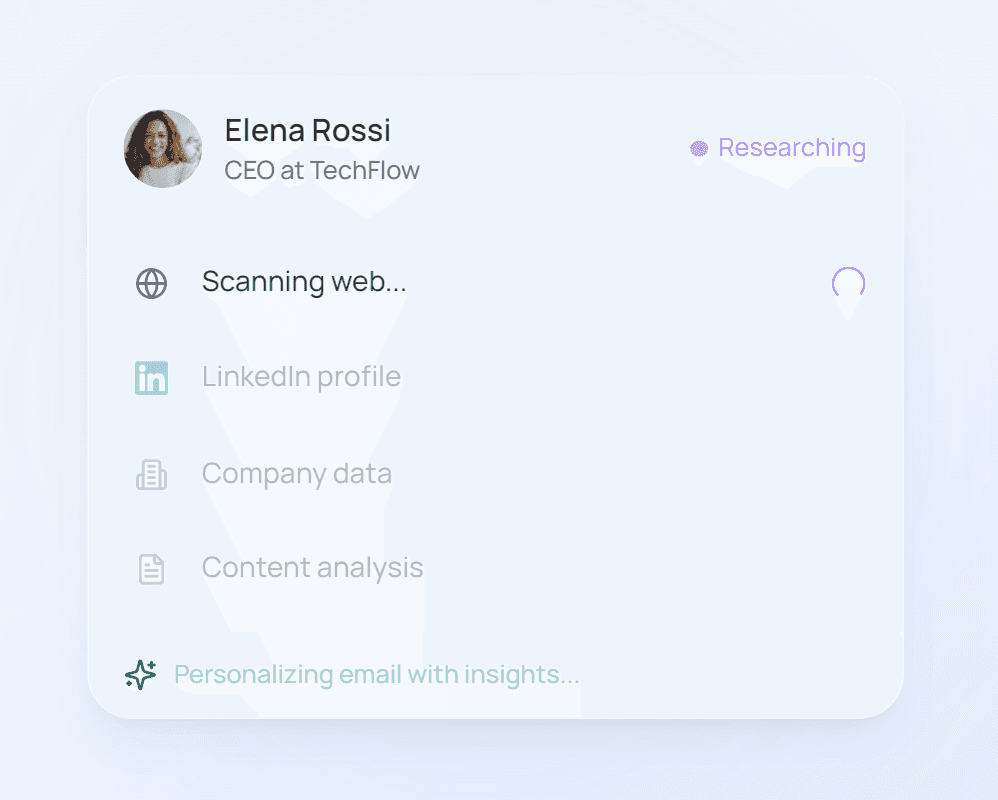
Where AI does the work
Reading eight sources on six hundred accounts a month is not something a small team does well, and it is exactly what a current-generation Claude Opus model is good at. So the model does the reading, the scoring and the first draft. A person owns the filter, the final wording and every single reply. That split isn't caution for its own sake — it's the same conclusion Close's 2026 AI-in-sales panel reached: treat AI as an assistant rather than a source of truth, and never fully outsource customer contact.
AI reads. People decide.
Who does what, step by step
Source sweep
- The model
- Reads the site, job ads, LinkedIn posts, funding and press coverage, changelogs and review sites for each account, and dates everything it finds.
- A person
- Decides which sources count, and drops anything that can't be linked to.
Qualification
- The model
- Scores every account against the six ICP checks and writes one line of reasoning, with a source, per check.
- A person
- Audits a sample of the passes and all of the near-misses, then tightens the filter. The model never has the final say on who gets contacted.
The angle
- The model
- Proposes the dated trigger and the consequence it usually causes.
- A person
- Kills anything undated, generic, or true of a hundred other companies.
The draft
- The model
- Writes to the four-line anatomy in chapter 05, per segment.
- A person
- Rewrites it in your voice. Anything that reads like a model wrote it gets binned — buyers spot it instantly and delete on sight.
Replies
- The model
- Classifies incoming mail into the five buckets and pulls the account context.
- A person
- Writes every reply. No auto-responder, no AI persona, no bot on a call.
Reporting
- The model
- Assembles the weekly numbers and the segment splits.
- A person
- Reads them, explains the bad weeks, and signs off before you see it.
What we will not automate
- No prospect on your list ever talks to a bot — not in email, not on LinkedIn, not on the phone.
- Nothing sends on model output alone. A person approves every sequence before it goes live.
- No claim goes into an email without a source we can link to. Model summaries get checked, because they invent quotes convincingly.
- No AI voice agents dialling your market. We call warm prospects, and the person who wrote the email makes the call.
- AI cadence gets edited out. Em-dash-heavy, uncanny, hyper-specific copy damages trust faster than a plain email ever would.
None of this is billed separately
Impressive is not the same as effective
Chapter 05
What we actually send
Our first email is four sentences. It names the change we noticed, says what usually happens next, offers one concrete outcome, and asks a question that's easy to answer honestly. No pitch deck, no 'quick question', no calendar link in email one.
Short, specific, and one question at the end.
The anatomy, line by line
Line 1 — the observation
“Saw you brought in a Head of Compliance last month.”
- Job:
- Prove this email was written for them and nobody else.
- Rule:
- Must reference something dated. If you can't date it, it isn't a signal.
Line 2 — the consequence
“Usually that means the reporting spreadsheet quietly becomes someone's full-time job.”
- Job:
- Show you understand what that change causes.
- Rule:
- Describe their world, not your product.
Line 3 — the relevance
“We handle that reporting for four other EU-regulated fintechs.”
- Job:
- One sentence on why you're a credible person to be writing.
- Rule:
- One proof point. Never three.
Line 4 — the question
“Worth a look, or is that already handled?”
- Job:
- Make replying easier than ignoring.
- Rule:
- Give them an easy 'no'. It doubles honest reply rates.
The rules we don’t break
- Under 90 words. If it needs scrolling on a phone, it's a pitch, not an email.
- No images, no tracking pixels, no attachments in the first two emails.
- One link maximum, and never in email one.
- Subject line is lowercase and four words or fewer.
- If it reads like a model wrote it, rewrite it. Em-dashes, 'I noticed that', and uncanny hyper-specific detail all get deleted on sight.
- Follow-ups add a new angle. 'Bumping this to the top of your inbox' is not an angle.
No calendar link in email one
Chapter 06
Keeping mail in the inbox
Every mailbox has an invisible allowance of trust. Bounces, spam complaints and sudden volume spikes spend it. Replies and steady sending top it up. Once it's gone, your mail stops reaching people and you find out three weeks later. Nearly every rule below exists to protect that allowance.
Deliverability is a budget you spend, not a setting you enable.
Never send from your primary domain
0 sends from the main domainBuy lookalike domains for outbound. If reputation goes wrong, your invoices and support mail are untouched.
Warm every mailbox before real sends
14–21 daysTwo to three weeks of low, replied-to traffic before the first campaign email. This is why week one produces nothing.
Cap volume per mailbox, then add mailboxes
≤ 30 sends / mailbox / dayThe safe number is far lower than tools suggest. Scale sideways, never upward.
Authenticate properly
SPF + DKIM + DMARCSPF, DKIM and DMARC on every sending domain, checked after every change. Missing DMARC is the most common cause of silent failure.
Verify before you send
Bounce rate under 2%Bounces are the fastest way to burn a domain. Verification is cheap; recovery is not.
Watch spam complaints weekly
Complaints under 0.1%Above 0.3% and providers start filtering silently. We pull volume back the same day.
Real opt-out on every message
Honoured same dayA plain sentence, honoured immediately. Hiding it costs more reputation than it saves sends.
Why week one produces no meetings
A brand-new mailbox that suddenly sends two hundred messages looks exactly like a compromised account. Providers respond by filtering everything you send, and you won’t be told.
So the first two to three weeks are low-volume, replied-to traffic that teaches providers the mailbox belongs to a real person. It feels like nothing is happening. It is the reason month three works.
Chapter 07
Handling replies
Teams obsess over the first email and then answer replies badly — too slow, too long, or with a calendar link and nothing else. We triage every reply into one of five buckets within a few hours, and each bucket has one job.
Most pipeline is lost in the reply, not the send.
Interested
Within 2 hours“Tell me more” / “Send me times”
Two concrete slots plus one line on what the call covers. No deck.
Curious but guarded
Within 2 hours“What does it cost?” / “How is this different?”
Answer the question directly, then ask the question that qualifies them.
Not now
Same day, then diarised“Revisit in Q3”
Agree, set a dated reminder, and send one useful thing before then.
Wrong person
Same day“That's not me, try Sam”
Thank them, ask for the intro rather than just the name.
Stop
ImmediatelyAny version of no, or an unsubscribe
Remove immediately across every channel and log it. No 'one last email'.
Never automate the reply
Chapter 08
When to pick up the phone
Cold dialling a purchased list is a numbers game with terrible odds and a bad reputation. Calling someone who opened your email four times and never replied is a different activity entirely — you have a reason, you have context, and the call takes ninety seconds.
We call warm prospects, not lists.
We call when
- Opened three or more times without replying
- Replied positively, then went quiet for five days
- A meeting no-show, called the same afternoon
- Lead Catcher flagged repeat visits to your pricing page
- A referral from someone who told us to try a colleague
How the call runs
- The person who wrote the emails makes the call. Context doesn't survive a handoff.
- Open by naming the email. You're following up, not cold calling.
- One goal: book fifteen minutes. Don't sell on the call.
- Ninety seconds, then let them go. Length isn't persistence.
- Every call gets a note in the shared channel, including the bad ones.
Chapter 09
What to measure
Six numbers tell you whether outbound is healthy. Everything else is decoration. Here they are, with the range we treat as healthy and what we do when one slips.
Reply rate
4–8%Whether you picked the right people and gave them a reason.
When it slips: Tighten the ICP first. Rewrite copy second. Never send more.
Positive reply share
35–50% of repliesWhether your offer matches the problem you claimed they have.
When it slips: Your relevance line is wrong, or you're reaching the wrong seniority.
Bounce rate
Under 2%Data hygiene. The leading indicator of domain trouble.
When it slips: Stop sending on that domain and re-verify the list.
Spam complaint rate
Under 0.1%Whether people feel your mail was worth receiving.
When it slips: Halve volume immediately and rewrite before resuming.
Meeting show rate
Above 75%Whether the booking was real interest or a polite escape.
When it slips: Qualify harder on the reply, and send a brief before the call.
Meeting-to-opportunity rate
Above 30%Whether outbound is producing the right kind of meeting.
When it slips: The ICP filter is too loose. Fix it upstream, not on the call.
Chapter 10
Ways this goes wrong
We have made most of these. They are listed here so you don’t have to.
Buying a 10,000-row list and sending to all of it
Bounces and complaints burn the domain in about three weeks, and the damage takes months to undo.
Research a few hundred accounts properly and send to those.
Treating merge tags as personalisation
Everyone has received a thousand of them. They signal automation, which is the opposite of the goal.
Find one dated change inside the business and open with it.
Sending from the company domain to save time
One bad campaign and your invoices start landing in spam.
Separate lookalike domains, warmed before use.
Judging a campaign in week one
Week one is warmup. There is nothing to judge, and reacting early makes it worse.
Judge at day 45, when there's enough reply data to mean something.
Automating replies
The reply is where trust is either built or lost. It's the least automatable step in the process.
A person answers everything, within hours.
Letting the model send
AI-written outreach that nobody edited reads like AI-written outreach. Executives delete it on sight, and it burns the domain that carried it.
Use the model for research, scoring and the first draft. A person approves every sequence and rewrites it in your voice.
Scaling a play that worked on ten accounts
A message tested on ten prospects and then fired at ten thousand finds every gap in your data and your positioning at once.
Use AI to decide who to contact and when, then grow volume only after the segment has replied at a rate you can repeat.
Optimising for meetings booked only
It quietly rewards booking anyone who says yes, and the sales team stops trusting the channel.
Track meeting-to-opportunity rate alongside volume.
Chapter 11
Plain-English glossary
Outbound has a lot of jargon and most of it hides something simple. Here it is without the mystique.
- ICP
- Ideal Customer Profile. A short list of pass/fail checks describing which companies are worth contacting.
- Signal / trigger
- A dated change inside a company that gives you a reason to write today rather than any other day.
- Sequence
- The planned series of touches across email, LinkedIn and phone for one prospect, and the timing between them.
- Warmup
- Two to three weeks of low-volume, replied-to sending that teaches inbox providers a new mailbox is trustworthy.
- SPF, DKIM, DMARC
- Three DNS records that prove you're allowed to send from a domain. Missing any of them sends your mail to spam.
- Sender reputation
- The running score inbox providers keep on your domain and IP. It decides whether you land in the inbox or the spam folder.
- Bounce
- A message rejected because the address doesn't exist. High bounce rates are read as a sign you bought a list.
- Deliverability
- Whether your mail reaches the inbox. Different from delivery, which only means it wasn't rejected outright.
- Positive reply
- A reply that moves things forward: interest, a question, or a redirect to the right person.
- Intent data
- Evidence someone is already researching a purchase — repeat site visits, pricing-page views, review-site activity.
- Enrichment
- Turning a company name into usable fields: verified contacts, headcount, tech stack, funding, recent posts. We do it with models reading public sources, then verify what gets used.
- Human in the loop
- A workflow where AI produces the work and a named person approves it before it reaches anyone outside the company. Every step we run is one of these.
- Hallucination
- A confident, plausible, invented detail in model output — a quote nobody said, a funding round that didn't happen. The reason every claim in our copy carries a source.
The plan, published before it’s finished.
Clients see this before they sign, not after. If something on here matters to you, say so on the call and it moves up.
- Live
Signal-led prospecting
Every account carries a dated trigger before it enters a sequence. No trigger, no send.
- Live
Model-read research, human-signed qualification
A Claude Opus-class model reads every public source on an account and scores it against your ICP checks with a citation per check. A person signs it off before anything is written.
- Live
Lead Catcher
Company-level identification of website visitors, feeding straight back into the prospecting queue.
- Building
Segment-level reply reporting
Reply and meeting rates split by segment and by angle, so you can see which story is working, not just the average.
- Building
Shared research library
The dossier behind every prospect — sources, dates and the model's reasoning — visible to you in the same place as the campaign, not locked in our tooling.
- Next
Self-serve playbook templates
The checklists on this page as something you can copy and run yourself, whether or not you hire us.
Three sources worth reading yourself.
Every rate in this document that isn’t ours is one of these. If you only read three things about outbound this year, read these rather than another LinkedIn thread.
Close
AI in Sales: What's Actually Changing (and What Isn't)
Where our AI rules come from: use it as an assistant rather than a source of truth, start with prioritisation instead of scale, and never fully outsource customer contact.
lemlist
7 best B2B intent data providers for outbound
The signal sources in chapter 03, and the benchmark behind them — intent-prioritised accounts converting at 21.3% against 8.4%.
Apollo
Why your emails land in spam — and how to fix it
Lookalike domains, two to four weeks of warmup, SPF/DKIM/DMARC and a bounce rate under 2% — the limits chapter 06 works to.
Run it yourself, or hand it over.
Both are fine. If you want the second one, book twenty minutes and we’ll run your numbers on the call — including the case where the answer is no.
Questions this didn’t answer? Try the FAQ.